


Frequently asked questions
How does Rain Alarm warn me about rain?
Rain Alarm monitors precipitation around your selected location and can notify you when it comes closer. The alarms use near-real-time radar and satellite data. Your alarm settings determine which precipitation triggers a notification.
Open the animated map to see where precipitation is and how it is moving.
How are rain alarms different from a weather forecast?
Rain alarms respond to precipitation that is already being observed nearby. This makes them more precise and useful for short-term rain warnings than a conventional forecast.
Rain Alarm also includes a conventional weather forecast showing expected conditions for the coming hours and days. Use the forecast to plan ahead and the rain alarms to react when precipitation approaches.
Will Rain Alarm warn me before it rains?
Rain Alarm is designed to warn you early enough to react before approaching rain reaches you. Its alarms are based on near-real-time observations of nearby precipitation. They do not predict the exact minute rain will start at your location.
What does a rain notification look like?
A notification shows how close precipitation is, its intensity, and how much of the monitored area it covers. Distances are displayed in kilometres or miles, according to your unit setting.
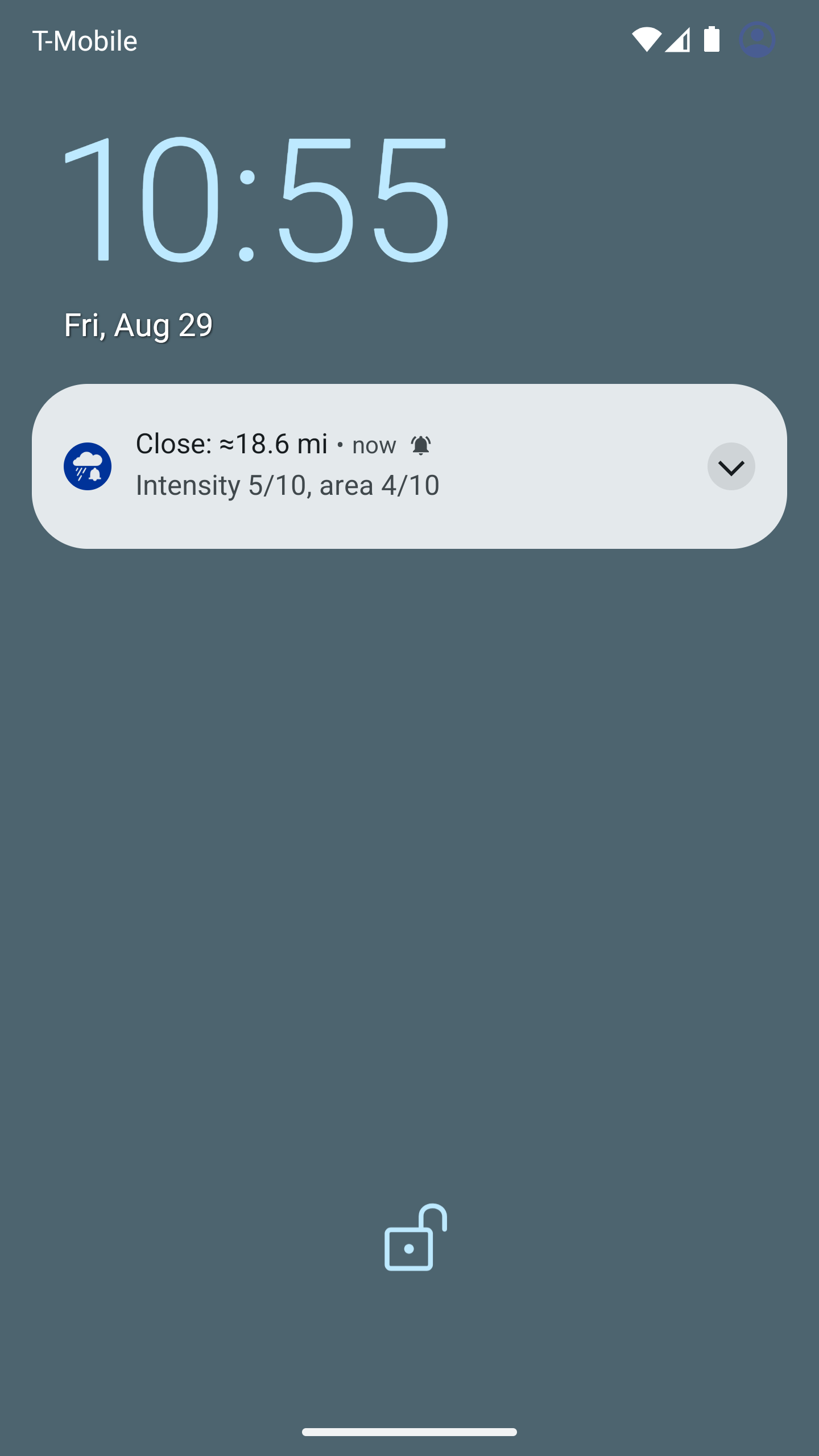
- ≈18.6 mi
The nearest detected precipitation is about 18.6 miles (30 km) from your selected location.
- Intensity 5/10
The strength of the detected precipitation on the app’s intensity scale.
- Area 4/10
How much of the monitored area contains precipitation, shown on a scale of ten.
The distance describes where precipitation is now; it is not an arrival time.
The appearance and available details depend on your platform.
Does Rain Alarm work where I live?
Yes—Rain Alarm offers worldwide coverage using weather radar and satellite data, so it works almost everywhere.
Radar provides more precise precipitation information where it is available. The extent of radar coverage is visible on the map, so you can check whether your location is covered. Satellite estimates extend coverage to regions without radar.
Does Rain Alarm use radar or satellite data?
Rain Alarm supports both. Weather radar provides detailed precipitation observations in regions with radar coverage. Satellite estimates help detect precipitation across a much larger area, including places without radar.
Satellite data is less precise than radar. You can choose between radar-only data and combined radar and satellite data in the settings.
How up to date is the precipitation map?
Rain Alarm displays new precipitation data almost as soon as it is published. Update frequency varies by country and data source. Weather services and satellite providers first need time to collect and process their observations, so there is a short delay between an observation and its appearance on the map.
Even with this short delay, Rain Alarm can warn you early enough to react to approaching rain.